This review contains affiliate links, which earn me a small commission when you click and purchase, at no extra cost to you. Thank you for supporting my small business and allowing me to continue providing you a reliable resource for clean book ratings.
In 2014, well-known poet Francis Blundy reads aloud a complex, lengthy poem he’s written for his wife, Vivien. The reading takes place at a dinner party the Blundys host for some close friends. Blundy has worked several months on the elaborate poem, created in a structure known as a corona, and is proud of his achievement. He reads it aloud to their guests to celebrate Vivien’s birthday, and then hands her the only written copy, saying she can do with it as she likes since it’s her gift.
The corona is never published; indeed, it’s never seen or heard again. The only people who know what it said are the few couples who were in attendance. And most of them partook liberally of good wine.
In ensuing decades, the public can only speculate about the poem; people only know it exists because of some articles written about the birthday dinner and the presentation of the poem. But the “Corona for Vivien,” its contents, and its fate become a literary mystery.
Over a century later, Thomas Metcalfe is a scholar at a university in what used to be the south of England. In 2119, the world is much different than it was in the days of the Blundys. Climate change had been occurring and discussed by scientists and the public, but a few uses of nuclear weapons a few decades later had accelerated huge changes in the earth. Water levels rose and led to many cities and parts of countries being completely submerged. What was Great Britain is now an archipelago.
Thomas has thoroughly researched the lives of the Blundys: Francis’s oeuvre, Vivien’s scholarly work, her romantic life and fairly brief marriage to a man who was diagnosed with Alzheimer’s only in his 40s. Thomas feels he knows them personally, especially Vivien; he has romanticized their era and lives. And against all odds, despite over a century of the poem not being found, he still is looking for the lost corona.
Then when he does find a clue that could lead to the poem, he finds a much more complicated, even shocking, truth.
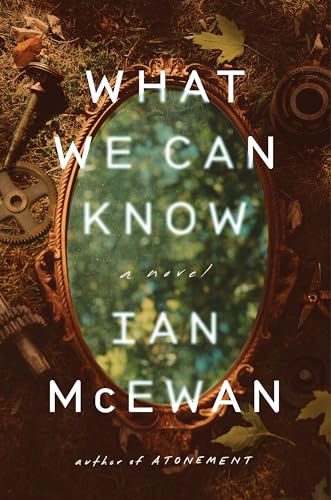
What We Can Know is a literary mystery: the plot is woven around the core of what happened to the poem. But it’s a story about misplaced nostalgia, about how people’s real lives are much messier than they may seem on the surface. I think it’s interesting that McEwan chose to set this book in a future where a lot of the western world has been submerged, where half of the population has died and life is much different. It could easily have been set 100 years ago in the real world now, or 100 years ago in an imagined future that’s not much different than now. But he chose this postapocalyptic setting, contrasting the two very different realities of now and his imagined future. (This would make for such a great discussion in a college class or in a good book club.)
I loved so much of what he wrote about AI and how it’s handled in the future, how technology is handled, how people look back on what our society does today: how most of us ignore climate change and simply go about our eat-drink-and-be-merry lives, how we blithely incorporate social media and AI without serious consideration of ramifications. I highlighted a lot of passages. (Class, let’s discuss…)
There’s a lot to dig into in What We Can Know, and I highly recommend it. McEwan is a skilled writer and this is one of his best, I think (though I personally loved Atonement, but I can’t really compare because they are very different books).
Rated: Moderate. Profanity includes 5 uses of strong language, around 6 instances of moderate profanity, a few uses of mild language, one instance of the name of Deity in vain, and a few instances of British (bl-) profanity. Sexual content includes references to frequent extramarital affairs, kissing, and sometimes a bit more past kissing. Violence includes some mentions of blood (don’t want to say more because it would be a spoiler).
Click here to purchase your copy of What We Can Know on Amazon.
*I received an ARC in exchange for my honest review.