This review contains affiliate links, which earn me a small commission when you click and purchase, at no extra cost to you. Thank you for supporting my small business and allowing me to continue providing you a reliable resource for clean book ratings.
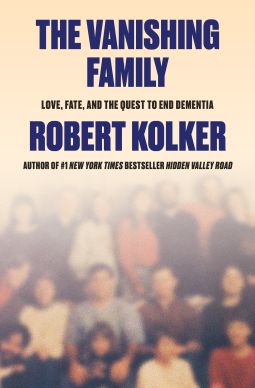
Having read Robert Kolker’s Hidden Valley Road, an excellent nonfiction book about a family of 12 children, half of whom were diagnosed with schizophrenia, I was ready for his latest, another true story of a large family hit hard by a devastating illness.
In The Vanishing Family, a couple in the Midwest have nine children. Five of them end up with a form of frontotemporal dementia. It was only fairly recently that they found out that’s what had been plaguing them. In the earlier (and middle) years of this book, the affected siblings’ behavior changed and they became quite different people. Often, they did things that were embarrassing to anyone else but not to themselves. And the rest of the family had no idea why.
“The symptoms were subtle at first — missed appointments, an uncharacteristic aloofness, an end to deep conversations. Slowly, impulse control and emotional depth became things of the past. Some of them simply stopped doing much of anything, ignoring their children and spouses. Others developed unpredictable, impulsive behavior, losing all semblance of empathy or a conscience; they broke laws, or had affairs, or drank with abandon. Still others took on an entirely new set of opinions and beliefs, all while maintaining a blithe, carefree disposition. Only gradually did it become clear that something ineffable about that person had been lost.
“The final stages of the family’s disease resembled more common neurological disorders like Alzheimer’s, only striking much earlier in life.”
The illness started with the family’s mother, Jean, though at the time no one realized that’s what it was. She changed, gave up parenting her last couple of kids, drank, didn’t care anymore about things she always had. And then she died young of breast cancer when she simply didn’t heed its visible spread on her chest.
It struck the second child, Christy, who ended up in the care of a younger sister, Sue, who never married. (And let me tell you, the work Sue put in caring for Christy for decades was herculean. Reading about it over the course of the book, as Christy got worse and as more siblings showed signs of decline, was beyond sobering. I cannot imagine being in her shoes. However, Sue simply told the author that she loved her sister, and she knew she was the one sibling who practically could be her caregiver.)
As years went by, the siblings watched and waited and wondered if it would happen to them. They found out for sure that it was genetic. They found out each had a 50/50 chance of inheriting and starting this decline in their 30s or 40s. And that if they had the gene, their kids then had that 50/50 chance too.
Now, it’s been about 15 years since they knew what exactly they have been going through. And they still are no better off, practically speaking, since there is no treatment or cure. Worse, their particular version of FTD is not very common, so as with many other diseases that only strike thousands or hundreds of people, funding and researchers aren’t lining up in droves to help.
The Vanishing Family covers the history of this one family over decades, and Kolker weaves in science about the brain, about dementia, about the parts of the brain that are damaged in FTD. We read about the very famous Phineas Gage, a railroad worker who had a metal rod pierce his cheek, eye and brain and come out through the top of his skull. I’ve read about him in many other places, but his case is certainly one that laid a groundwork for the evolution of medical/scientific understanding of the temporal lobe.
We get fact-checked on myths people still think are true; we are taken through the pertinent science over decades. Finally, the book concludes with what studies may be making some progress toward treatment or cure, and how this family plays into them. Barb, the youngest, has particularly made it her mission to get involved with fundraising and awareness-raising.
There’s hope on the horizon, surely, but this disease is a tricky one, and this family has gone through a lot. Some members of the third generation in the family are still facing uncertain, scary futures.
Hopefully, within a decade or two this will all be history. In the meantime, books like these get the word out: about the science, but also about the real people who are impacted so severely and personally by this disease.
The Vanishing Family is another fascinating book, and an important one.
Rated: Moderate. Profanity includes 1 use of strong language, a couple instances of moderate profanity, about 6 or 7 uses of mild language, and 1 instance of the name of Deity in vain. Some people have alcohol addictions; there are references to affairs.
Click here to purchase your copy of The Vanishing Family on Amazon.
*I received an ARC in exchange for my honest review.