This review contains affiliate links, which earn me a small commission when you click and purchase, at no extra cost to you. Thank you for supporting my small business and allowing me to continue providing you a reliable resource for clean book ratings.
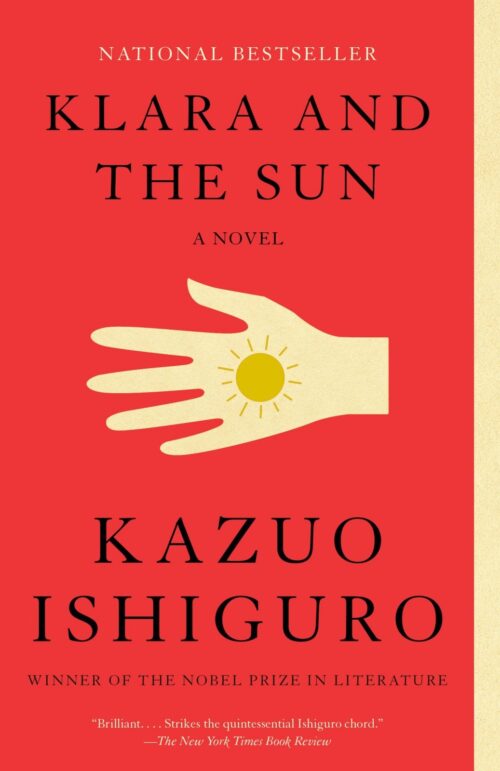
I’ve read and appreciated two of Kazuo Ishiguro’s earlier novels: the classic Never Let Me Go and The Buried Giant. Klara and the Sun feels very similar to Never Let Me Go in tone and in that many details of the reality of life for people in this book are only hinted at. And in many ways, the full picture is never revealed, even by the end. Ishiguro only puts in small clues about the most important parts of the story. It has a dystopian slant, but when it comes down to it, this is a book about the devotion of a very observant and tender-hearted robot.
Klara is an Artificial Friend. She has waited in a store with other AFs for just the right child to choose her to take home. As she stands in the store day after day, she observes those who come into the store and, when she is standing at the front, she watches the people and events that occur outside on the street. She is constantly thinking and evaluating and wondering if her conclusions are correct.
One day, she does finally get chosen by a girl who has visited her a couple of times previously. Klara is very pleased that she gets to be the friend to Josie. She is dedicated to Josie’s well-being and happiness and finds herself sad when Josie experiences problems. Josie has health issues, and Klara wishes that she could fix things for her. She may have a way, too, though it’ll be a long shot.
Klara and the Sun is an examination of the heart, of relationships, and of what one will choose to sacrifice to help another. This novel is one that would be excellent to discuss in a book club. There’s a lot going on: again, mostly under the surface and just hinted at, and it would be fascinating to hear how others interpret things. Ishiguro is a gifted writer (a Nobel laureate) who delicately explores what it is to love.
Rated: Moderate. Profanity includes 5 uses of strong language, around 7 instances of moderate profanity, about 15 uses of mild language, and a dozen instances of the name of Deity in vain. There’s no sexual content except young teens joking that they won’t be engaging in it when left alone.
Click here to purchase your copy of Klara and the Sun on Amazon.