This review contains affiliate links, which earn me a small commission when you click and purchase, at no extra cost to you. Thank you for supporting my small business and allowing me to continue providing you a reliable resource for clean book ratings.
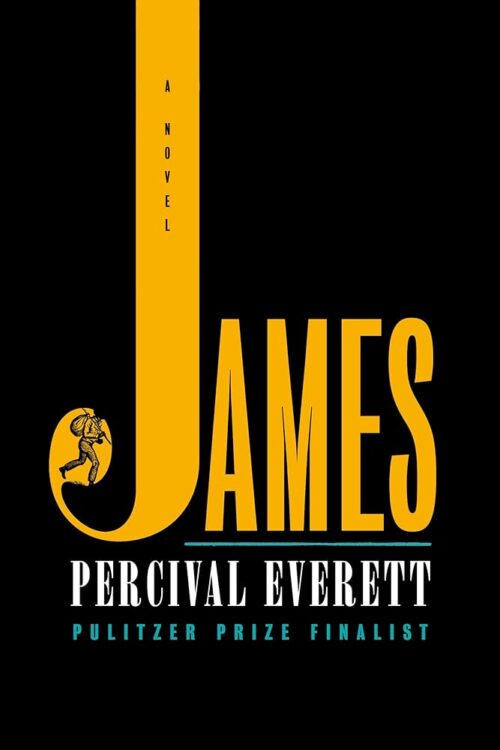
I bought James not long after it came out, because I knew it would be an important book and it had a long wait time at the library. But, of course, it took me a while to get to (ha ha could have just waited on that library queue). I’m just glad I finally did read it (I was pushed along by Katie Couric). I had wanted to re-read The Adventures of Huckleberry Finn, which, along with The Adventures of Tom Sawyer, I had read as a young teen. Since that was, ahem, decades ago, I thought it would be nice to have that source book fresh in my mind. But … of course… I just didn’t take time to do that. I figured I may never get to James if I waited on reading Huck. Now I still do want to read it again.
In this book, Percival Everett writes the story of Jim from Adventures of Huckleberry Finn. Here, he’s the hero. The enslaved Jim learns that he is going to be sold and separated from his wife and daughter. So he decides to go hide on an island in the Mississippi River until he can figure out a plan. At the same time, Huck has faked his own death to get away from his violent drunkard father.
The two end up on a raft together on the river, and they separate and meet up again a few times throughout the book. Jim is shown to be an intelligent, thoughtful man who loves to read and learn, who considers carefully how to approach the situations he’s faced with. Danger is around every turn, whether it’s from slave owners, scam artists, or nature. But Jim is intent on finding freedom for himself, and then for his family.
I was enthralled with James. It’s fairly simple reading, with plenty of action to keep the reader’s attention. (Honestly, I may have felt a bit hesitant to read it if it was “serious” reading that I’d have to dig down into and concentrate hard, and I’d have to be in the right frame of mind, etc., and it wasn’t that way.) And, of course, with any book whose main character is enslaved, I found myself enraged at all of it: the acceptance by so many of the inferiority of a group of people, the acceptance that those people deserved to be treated as cruelly as they were, and the casualness with which those atrocities were carried out. The book is not graphic, which was welcome. Even so, the lack of many details didn’t take away from the reality of that brutality.
I haven’t read any other of Everett’s books, but I can tell he is an experienced, skilled writer. James deserved the Pulitzer Prize. I highly recommend.
Rated: Moderate. Profanity includes 1 use of strong language, 8 instances of moderate profanity, about 35 uses of mild language, and about 15-20 instances of the name of Deity in vain. There are also about 70 uses of the N-word. Violence includes several references to rape, one that occurs on the page, but with few details; whippings of slaves, talk of hangings and many other instances of treatment of enslaved people.
Click here to purchase your copy of James on Amazon.